

Download Full Report
October 5, 2026
Axios npm Supply-Chain Compromise (2026-03-31)
Protos AI Threat Intelligence
#SupplyChain #npm #Axios #CyberSecurity #ThreatIntelligence #CTI #ZshBucket #STARDUSTCHOLLIMA
Protos AI Threat Intelligence
TLP:CLEAR
Protos AI Threat Intelligence
2026-04-07
| Attribute | Value |
|---|---|
| Risk Level | HIGH |
| Confidence | High (occurrence/mechanics) · Medium (attribution) |
| Key Finding | Official Axios npm package was compromised on 2026-03-31; malicious releases delivered a typosquatted dependency that fetched multi-platform payloads from an externally hosted C2. |
| Primary Action | Revoke/rotate CI and developer credentials, block C2 network elements, and collect package tarballs and build logs. |
axios@1.14.1 and axios@0.30.4). The malicious releases introduced a typosquatted dependency (plain-crypto-js@4.2.1) whose postinstall script collected environment data and fetched platform-specific payloads from an externally hosted C2. Developer machines, CI/CD systems, and downstream consumers are at highest risk.
| Scope Item | Details |
|---|---|
| Investigation Focus | Supply-chain compromise of the Axios npm package and resulting payload delivery. |
| Time Period | 2026-03-08 → 2026-04-07 |
| Sources Used | Threat intelligence feeds, vendor writeups, antivirus scan results, DNS analysis, OSINT research. |
| Methodology | Review of structured claims and vendor reports, enrichment of IOCs, timeline reconstruction, and prioritized remediation guidance. |
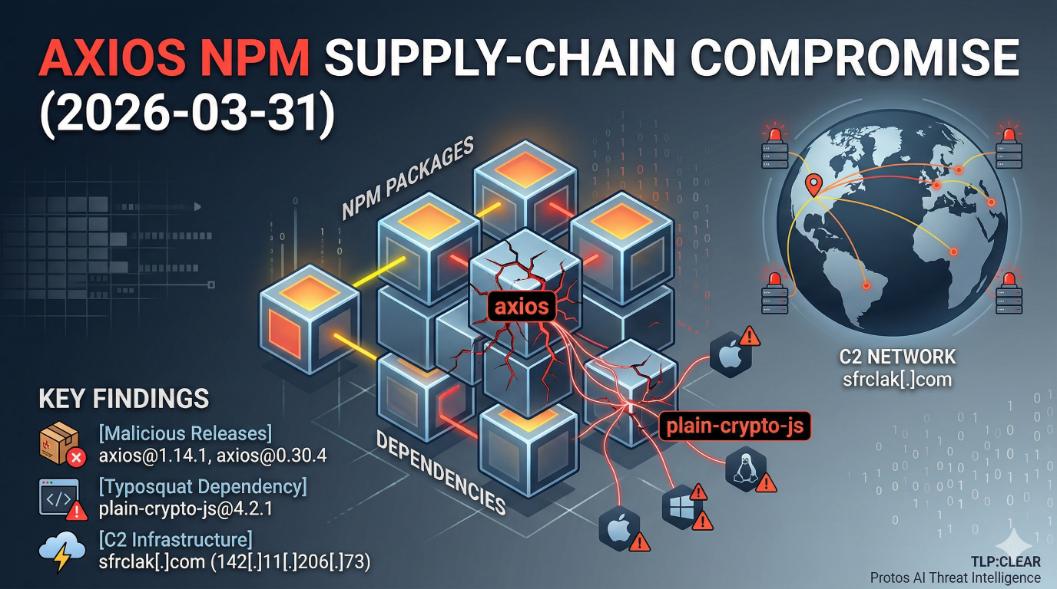
The official Axios npm package was compromised and malicious releases (axios@1.14.1 and axios@0.30.4) were published on 2026-03-31. Multiple vendors corroborated this across the compromise window.
Malicious releases introduced plain-crypto-js@4.2.1 — a typosquatted dependency with a postinstall hook that collected environment data and retrieved payloads from the C2.
Payload retrieval occurred from sfrclak[.]com and host IP 142[.]11[.]206[.]73. The domain served payloads on port 8000 with broad AV detections reported.
Platform-specific payloads (macOS, Windows, Linux) were delivered and executed after retrieval. Payload SHA-256s for each platform were observed in vendor dissections.
Developers, CI/CD systems, and downstream consumers faced elevated risk. Install-time execution exposes environment variables, secrets, and tokens to postinstall code.
CrowdStrike attributed the activity to STARDUST CHOLLIMA with moderate confidence. Attribution is ambiguous due to shared/leased infrastructure and should be treated as tentative.
Passive DNS probes returned no records for sfrclak[.]com in some providers, suggesting short-lived registration. IP 23[.]254[.]203[.]244 shares a banner hash with the C2 host and is cited as related infrastructure.
Scope of Data Exfiltration: Insufficient evidence to determine the exact breadth of secrets or data exfiltrated. Vendors confirmed environment collection behavior but have not disclosed confirmed exfiltrated artifacts. Risk: HIGH if secrets were exposed.
| Target | Hosting | Key Observations |
|---|---|---|
sfrclak[.]com | 142[.]11[.]206[.]73 | Served payloads on port 8000; multiple AV detections and related file artifacts. |
23[.]254[.]203[.]244 | Related IP (shared banner hash) | Vendor-cited related infrastructure; relationship requires telemetry confirmation. |
| Attribute | Details |
|---|---|
| Family | ZshBucket (vendor designation) |
| Type | Multi-platform loader / stealer |
| Capabilities | Environment collection, payload retrieval, potential persistence and credential theft |
| C2 | sfrclak[.]com (142[.]11[.]206[.]73) |
| Risk Factor | Rating | Justification |
|---|---|---|
| Threat Sophistication | HIGH | Supply-chain compromise with multi-platform payload delivery indicates advanced operational capability. |
| Potential Impact | HIGH | Secrets in developer and CI environments could be exposed, enabling lateral movement or supply-chain contamination. |
| Likelihood of Exploitation | HIGH | Many environments perform npm install in build contexts; postinstall hooks run automatically in common pipelines. |
| Overall Risk | HIGH | Immediate containment and remediation required. |
hxxp://sfrclak[.]com:8000/6202033 and 142[.]11[.]206[.]73 in logs for 2026-03-31 → 2026-04-02.| Type | Indicator | Context | Risk |
|---|---|---|---|
| Domain | sfrclak[.]com | C2 domain serving payloads | HIGH |
| URL | hxxp://sfrclak[.]com:8000/6202033 | Payload retrieval path | HIGH |
| IP | 142[.]11[.]206[.]73 | C2 host; broad AV detections | HIGH |
| IP | 23[.]254[.]203[.]244 | Related infrastructure (shared banner hash) | MED-HIGH |
| Type | Hash (truncated) | Platform | Context |
|---|---|---|---|
| SHA256 | 92ff0877...c9645a | macOS | Vendor-observed payload hash |
| SHA256 | ed8560c1...5f815c | Windows | Vendor-observed payload hash |
| SHA256 | fcb81618...0375cf | Linux | Vendor-observed payload hash |
| Source Type | Description |
|---|---|
| Threat Intelligence / Vendor Writeups | Microsoft, Datadog, CrowdStrike vendor analyses and public advisories. |
| Antivirus / Malware Analysis | AV snapshots and file hash observations from public malware feeds. |
| DNS Analysis | Passive DNS lookups reported by vendors and public passive DNS providers. |
| OSINT / Community Reporting | Aggregated news and community findings confirming package publish events. |
Generated by Protos AI · TLP:CLEAR · 2026-04-07
Protos AI collects the threat signals behind reports like this — upstream and at machine scale — then analyses what bears on your environment. See it on your own data.
Make sense of the upstream signals where adversaries hide — before the breach, not after.
.png)