Threat Intelligence Report — CVE-2026-18577, Storm-1175, and StormEncryptor
TLP:CLEAR
Analyst: Protos AI Threat Intelligence
Date: 2026-08-13
Reporting Period: 2026-07-31 → 2026-08-13
Executive Summary
Overall Severity
High
Confirmed active exploitation of a privileged RMM platform with downstream customer impact potential.
Confidence
Medium
Likely, but not fully confirmed for the Storm-1175 to CVE-2026-18577 linkage.
Reporting Period
2026-07-31 → 2026-08-13
Covers first suspicious activity through the current reporting cutoff.
Recommended Action
Patch and hunt now
Within 24 hours
Bottom line: CVE-2026-18577 was actively exploited and should be treated as a live intrusion path, not a theoretical weakness. The strongest public evidence confirms exploitation of N-able N-central and a cascade into managed systems, while the Storm-1175 → CVE-2026-18577 → StormEncryptor chain is best treated as likely, not fully proven.
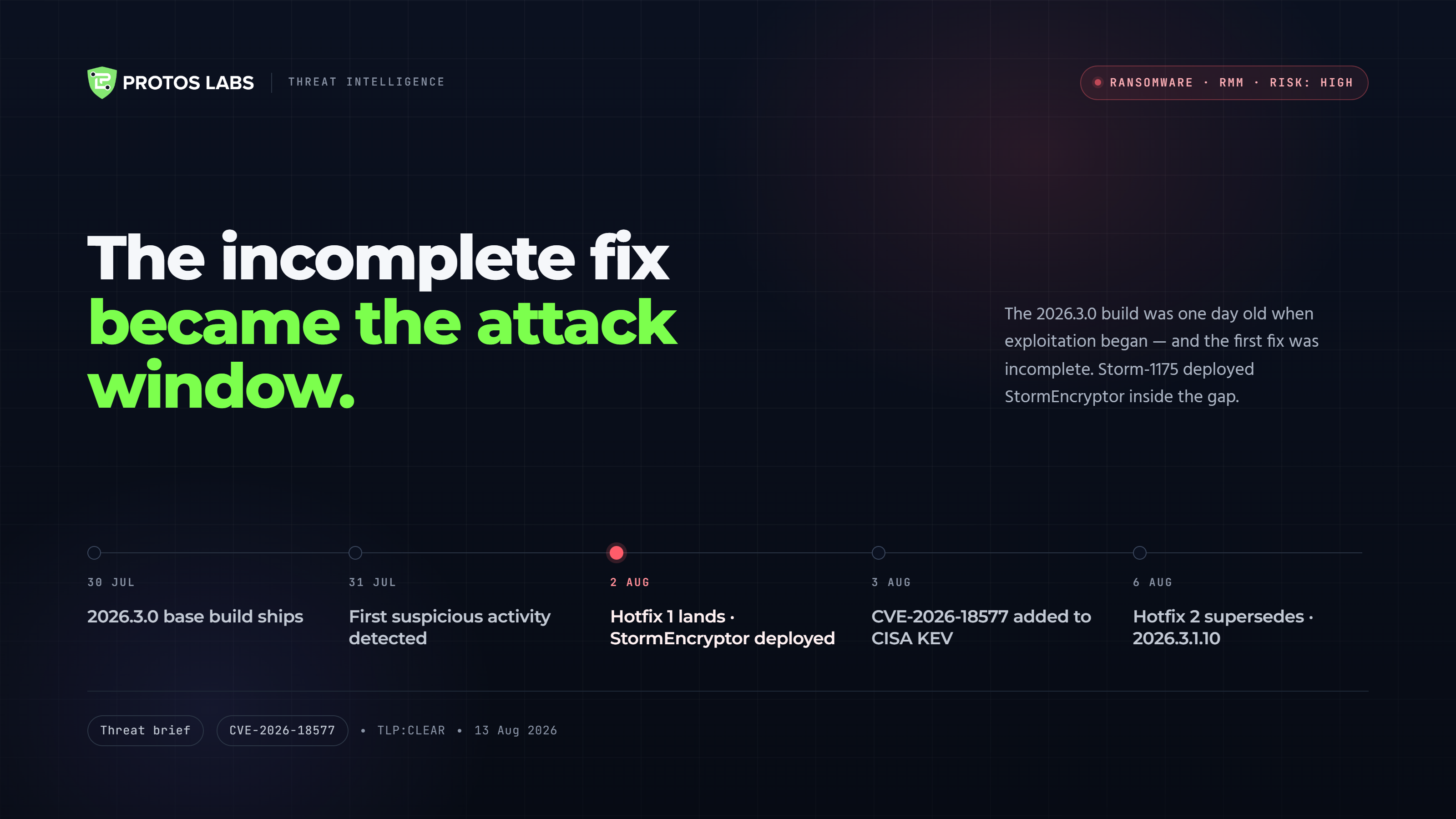
The reporting window shows a fast-moving sequence: the 2026.3.0 base build shipped on 2026-07-30, one day before the first suspicious activity was detected on 2026-07-31 by N-able’s Adlumin MDR. Per N-able’s own account, the company published guidance, registered CVE-2026-18556, released Hotfix 1 (2026.3.1.7), and registered CVE-2026-18577 across 2026-08-01 → 2026-08-02; CVE-2026-18577 was added to KEV on 2026-08-03, CVE-2026-18556 followed on 2026-08-04, and Hotfix 2 (2026.3.1.10) shipped on 2026-08-06. That sequence is operationally important because the patch lineage itself became part of the adversary’s window of opportunity — the base build was barely a day old when exploitation began, and the incomplete first fix left a follow-on gap.
For downstream leaders, the question is not only whether the N-central server was hit; it is whether managed endpoints, credential stores, and remote access tooling were exposed through the management plane. The evidence supports a material supply-chain style blast radius for MSSPs and multi-site enterprises, but the sector risk is not uniform. Healthcare is highest concern because a compromised management plane can interrupt patient care, affect medical-device or clinical workflow continuity, and create HIPAA Security Rule and breach-notification questions if ePHI is accessed or rendered unavailable. Retail is driven more by payment-environment disruption and consumer-data exposure, with PCI-adjacent operational fallout if store or POS support systems are touched. Financial Services sits near the top end because GLBA and the FTC Safeguards Rule push incident response, access control review, and third-party oversight, while public companies may also face SEC disclosure if the incident is material. Singapore-managed clients add a PDPA and MAS TRM overlay: personal-data notification thresholds and regulated-firm resilience expectations make downstream customer notification and legal review more urgent, especially where financial institutions are involved.
Key Judgments
1. CVE-2026-18577 was actively exploited in the wild against N-able N-central HIGH CONFIDENCE
This is almost certain because CISA added the issue to KEV on 2026-08-03 and N-able documented suspicious activity beginning 2026-07-31 in a customer environment.
2. CVE-2026-18577 is best understood as an incomplete-patch follow-on to CVE-2026-18556 HIGH CONFIDENCE
The patch lineage is effectively confirmed because CISA explicitly described the later issue as the result of an incomplete patch, and Rapid7 independently characterized it the same way.
3. Storm-1175 is the most likely actor associated with the later StormEncryptor activity, but the direct August Microsoft source text is missing MEDIUM CONFIDENCE
It is likely that Storm-1175 is linked to StormEncryptor because Microsoft’s April baseline establishes the actor’s tradecraft and the recovered Microsoft Threat Intelligence post says the actor likely exploited CVE-2026-18577, but the direct August blog post was not recovered. The report therefore cites the most specific recoverable Microsoft source — the social post — and notes that the full August article remains unavailable.
4. The July 31 N-able activity and the Storm-1175 campaign are temporally linked but not yet proven to be the same cluster LOW CONFIDENCE
Even though the timelines are adjacent and share the same product family, the sources do not establish identity with certainty, so this should be reported as an open attribution question rather than a settled fact.
What We Did
| Scope Element | Coverage | Sources Used | Notes |
|---|
| Objective | Assessed CVE-2026-18577 exploitation, Storm-1175 linkage, StormEncryptor deployment, and downstream MSP/customer impact. | investigation_objective.md | Aligned to security-leader and incident-response decision making. |
| Time Window | 2026-07-31 to 2026-08-13 | CISA, N-able, Microsoft-linked coverage, Rapid7 | Captures first activity through current cutoff. |
| Method | Cross-checked vendor statements, public reporting, and source-conflict notes; preserved uncertainty where direct confirmation was missing. | Analysis review, primary-source closure artifact, supporting workstreams | Conflicting reporting is shown explicitly below. |
| Deliverable Focus | Confirmed scope vs estimated scope, mechanics, impact, kill chain, and priority actions for MSSPs. | claims.json and artifact workstreams | No markdown sidecar was produced. |
Evidence
Confirmed scope versus estimated or unknown scope
| Item | Confirmed | Estimated / Likely | Unknown |
|---|
| Exploitation status | CVE-2026-18577 was actively exploited and added to CISA KEV. | None required. | Exact exploit chain and tooling used at initial access. |
| Actor linkage | Storm-1175 is a proven high-velocity ransomware actor from Microsoft’s April reporting. | Storm-1175 is likely associated with the August StormEncryptor activity. | Whether the July 31 N-able incident and the Storm-1175 campaign are the same cluster. |
| Victim scope | N-able said only a limited number of customers were impacted. | Downstream blast radius can include managed endpoints and customer networks. | Exact victim count and complete sector breakdown. |
| Remediation lineage | Hotfix 1 (2026.3.1.7) and Hotfix 2 (2026.3.1.10) were released; Hotfix 2 supersedes Hotfix 1. | Hotfix 2 is the safer remediation target for delayed adopters. | Whether every environment validated the fix after deployment. |
Vulnerability mechanics and patch lineage
| Topic | CVE-2026-18556 | CVE-2026-18577 | Operational takeaway |
|---|
| Relationship | Earlier issue in the N-central exposure sequence. | Later authentication-bypass flaw described as the result of an incomplete patch. | Patch validation must go beyond the first fix because the later issue follows the earlier one. |
| Remediation | Guidance and CVE registration began after the 2026-07-31 detection; the 2026.3.0 base build had shipped only on 2026-07-30. Added to KEV 2026-08-04. | Hotfix 1 (2026.3.1.7) released 2026-08-02; Hotfix 2 (2026.3.1.10) on 2026-08-06 superseded it. Added to KEV 2026-08-03. | Delayed patching leaves a window for follow-on exploitation; validate the fix after deployment. |
| Confidence | High that it predates 18577. | High that it is the later, KEV-listed, actively exploited issue. | High confidence that the issues are lineage-linked; lower confidence on exact attacker use. |
One-sentence conversion path: CVE-2026-18577 enables unauthenticated access to the N-central management plane, which can then be used to reach managed endpoints, register persistent tunnels, and pivot into ransomware deployment on downstream systems.
StormEncryptor kill chain
| Stage | Observed / Reported Activity | Confidence | Implication |
|---|
| Initial access | Likely exploitation of CVE-2026-18577 against N-central; direct Microsoft confirmation is absent in the recovered primary text. | Medium | Attackers may gain management-plane access without valid credentials. |
| Post-compromise access | Use of Take Control and later Cloudflare Tunnel persistence. | High | Adversaries can maintain access even after the original path is disrupted. |
| Credential / movement | Storm-1175 tradecraft includes PowerShell, PsExec, Impacket, Mimikatz, and PDQ Deployer. | High | Shows a mature post-exploitation toolkit, not a one-off exploit. |
| Exfiltration / encryption | Microsoft reporting ties the actor to Bandizip and Rclone before ransomware deployment. | High | Data theft likely preceded or accompanied encryption. |
| Ransomware deployment | StormEncryptor deployment began on 2026-08-02 in Microsoft-linked reporting. | Medium | But exact initial access vector remains unconfirmed. |
Downstream / supply-chain impact analysis
| Audience | Impact Path | Risk | Operational concern |
|---|
| MSSPs / RMM operators | Compromise of the central management console can reach many tenants and endpoints quickly. | High | Single-platform compromise becomes a multi-client incident. |
| Retail | Store networks and operational endpoints may be reached through the management plane. | High | Business interruption and payment-environment concerns. |
| Healthcare | Managed devices may include clinical or administrative systems. | High | Potential patient-safety and notification implications. |
| Financial Services | Central admin compromise can expose privileged service paths and customer-facing systems. | High | Potential regulatory, continuity, and fraud-adjacent impacts. |
The downstream impact should be treated as supply-chain style even when the victim is technically a single provider, because the management platform can bridge into many managed endpoints. N-able’s own statements about a limited number of impacted customers do not eliminate the broader blast radius risk for organizations that rely on centralized remote management.
IOCs
How to use this table. Two of the most-cited indicators — svchost.exe and a Cloudflared service — are legitimate, extremely common filenames and tools. The indicator is not the name; it is the anomalous context (wrong file path, unexpected host, a service masquerading as something else). Alerting on the bare names will generate high false-positive volume and risks disabling a legitimate Windows process or a sanctioned Cloudflare tunnel. Treat the SHA-256 hash and the attacker IPs as the high-fidelity hunt set; treat the rest as context-dependent leads requiring analyst validation. All indicators are a starting point, not a complete picture — consistent with N-able’s own caveat, a clean result does not confirm an environment was not affected.
High-fidelity indicators (hunt first)
| Type | Indicator | Detection logic | Confidence | Source |
|---|
| Hash | c19ded65e822bb43ad0381c58abf33b7c8890f7bcc7125058a0c849c7e1a6054 | Microsoft Defender detection for the StormEncryptor payload (Ransom:Win64/StormEncryptor). Block and alert on hash match. | HIGH | Microsoft-linked |
| IP | 173[.]249[.]252[.]200, 87[.]249[.]138[.]34, 37[.]19[.]210[.]32, 68[.]235[.]46[.]214, 185[.]156[.]46[.]150, 23[.]234[.]94[.]43, 37[.]153[.]90[.]88, 68[.]235[.]46[.]235, 92[.]118[.]112[.]181 | Attacker IPs from N-able firewall guidance (initial set of six plus later additions). Search firewall, proxy, and N-central access logs for inbound or C2 traffic; alert on any match. | HIGH as IOCs / MED attribution | N-able |
Context-dependent indicators (validate before acting)
| Type | Indicator | What actually signals compromise | Confidence | Source |
|---|
| File (anomalous path) | svchost.exe in a user’s Documents folder | Legitimate svchost.exe lives only in C:\Windows\System32 (and SysWOW64). A copy in a user-profile or Documents path is the indicator. Hunt for svchost.exe where the parent path is not System32 or SysWOW64. | MED–HIGH | N-able |
| Service (masquerading) | Cloudflared service — especially disguised as a Microsoft update | Cloudflared is a legitimate tunnelling tool. The signal is an unexpected Cloudflared service on a managed endpoint with no sanctioned use, or a tunnel service named to impersonate a Microsoft update (per Sophos). Hunt for newly registered tunnel services and outbound traffic to Cloudflare tunnel infrastructure on hosts with no approved tunnel. | MEDIUM | N-able / Sophos |
| Account (rogue) | Domain account named veeam (or other unexpected new admin/service accounts) | In Sophos’s confirmed intrusion the actor created a rogue veeam-named domain account and reset admin passwords. Hunt for recently created privileged or domain accounts — especially names impersonating backup software — and admin password-reset events since 2026-07-31. | MEDIUM | Sophos |
| Behaviour | N-central Take Control sessions to managed endpoints | A legitimate feature abused for lateral access. The signal is Take Control activity that does not map to a known technician or ticket. Review all Take Control activity since 2026-07-31 (also a CISA FCEB requirement). | MEDIUM | N-able / CISA |
Vendor detection tooling. N-able has published a custom N-central service template that scans Windows endpoints for known IOCs (developer.n-able.com/n-central/recipes/cve-2026-18577-detection). N-able notes it checks only currently known indicators and that a clean result is not a guarantee — use it as one layer alongside a thorough review of logs, accounts, and activity.
Alternative Hypotheses
| Finding | Alternative Explanation | Why Accepted / Rejected |
|---|
| Storm-1175 linkage | StormEncryptor could be a separate opportunistic ransomware cluster using similar tooling. | Possible, but rejected as the leading view because Microsoft-linked coverage repeatedly ties the activity to Storm-1175 and the toolchain overlaps with established actor tradecraft. |
| July 31 activity | The July 31 N-able incident might be unrelated to the August StormEncryptor reporting. | Possible, but not rejected entirely; the sources show temporal adjacency and common product focus, yet they do not prove the same cluster. |
| Exact initial access vector | CVE-2026-18577 may not be the path used by the actor in the StormEncryptor case. | Accepted as a caveat because Microsoft explicitly said it had not confirmed the exact vulnerability, even while assessing CVE-2026-18577 as likely. |
Information Gaps & Limitations
- Gap: Exact victim count and full sector breakdown remain unavailable. Impact: Limits precise exposure sizing and notification planning.
- Gap: Direct Microsoft August source text was not fully recovered. Impact: The Storm-1175 → CVE-2026-18577 → StormEncryptor link must remain likely rather than confirmed.
- Gap: The July 31 N-able incident and the August Storm-1175 campaign are not conclusively identical. Impact: Analysts should avoid collapsing them into one event without additional corroboration.
- Gap: Full root-cause analysis and complete IOCs were still pending in the vendor material at the cutoff. Impact: Defensive hunts should assume additional indicators may still emerge.
- Gap: Validation status of all customer environments after Hotfix 2 is unknown. Impact: Residual risk persists until environments are checked and logs are reviewed.
Recommendations
- Patch all N-central instances to Hotfix 2 immediately — Hotfix 2 (2026.3.1.10) supersedes the first fix and is the safest remediation target for both hosted and self-hosted environments.
- Hunt for compromise in the management plane and downstream endpoints — Search for suspicious logins, unexpected accounts, Take Control abuse, Cloudflared services, and signs of managed-device pivoting.
- Review credential hygiene and remote-access exposure — Reset privileged credentials, inspect service accounts, and disable or restrict unnecessary remote management pathways used by N-central.
- Notify downstream customers and legal/compliance stakeholders — MSSPs should assume supply-chain style impact may extend to clients in Retail, Healthcare, and Financial Services, with possible regulatory obligations.
- Preserve logs and escalate telemetry retention — Keep N-central, endpoint, authentication, and proxy/tunnel telemetry long enough to support forensics and legal review.
Sources
- CISA — https://www.cisa.gov/known-exploited-vulnerabilities-catalog
- N-able — https://www.n-able.com/blog/n-central-security-update-august-6-2026
- N-able Status — https://status.n-able.com/2026/08/02/n-central-2026-3-hotfix-1-mitigation-for-cve-2026-18577/
- Microsoft-linked coverage — https://www.microsoft.com/en-us/security/blog/
- Rapid7 — https://www.rapid7.com/blog/post/2026/08/04/cve-2026-18577-n-able-n-central-authentication-bypass-exploited-in-the-wild/
- The Hacker News — https://thehackernews.com/2026/08/china-linked-hackers-deploy-new.html


.png)