Threat Intelligence Report — Upbound Group / Acima Incident
TLP:CLEAR
Analyst: Protos AI Threat Intelligence
Date: 2026-07-30
Reporting Period: 2026-04-01 to 2026-07-30
Executive Summary
Overall Severity
High
Confirmed cyber incident translated into measurable downstream fraud losses.
Confidence
High — likely
Confirmed on the loss figure and breach-to-fraud linkage; unknown on actor, exact fields, and full control failures.
Reporting Period
2026-04-01 → 2026-07-30
Investigative window from the objective; incident disclosure anchored on 2026-07-21.
Recommended Action
Harden origination fraud controls
Priority Review
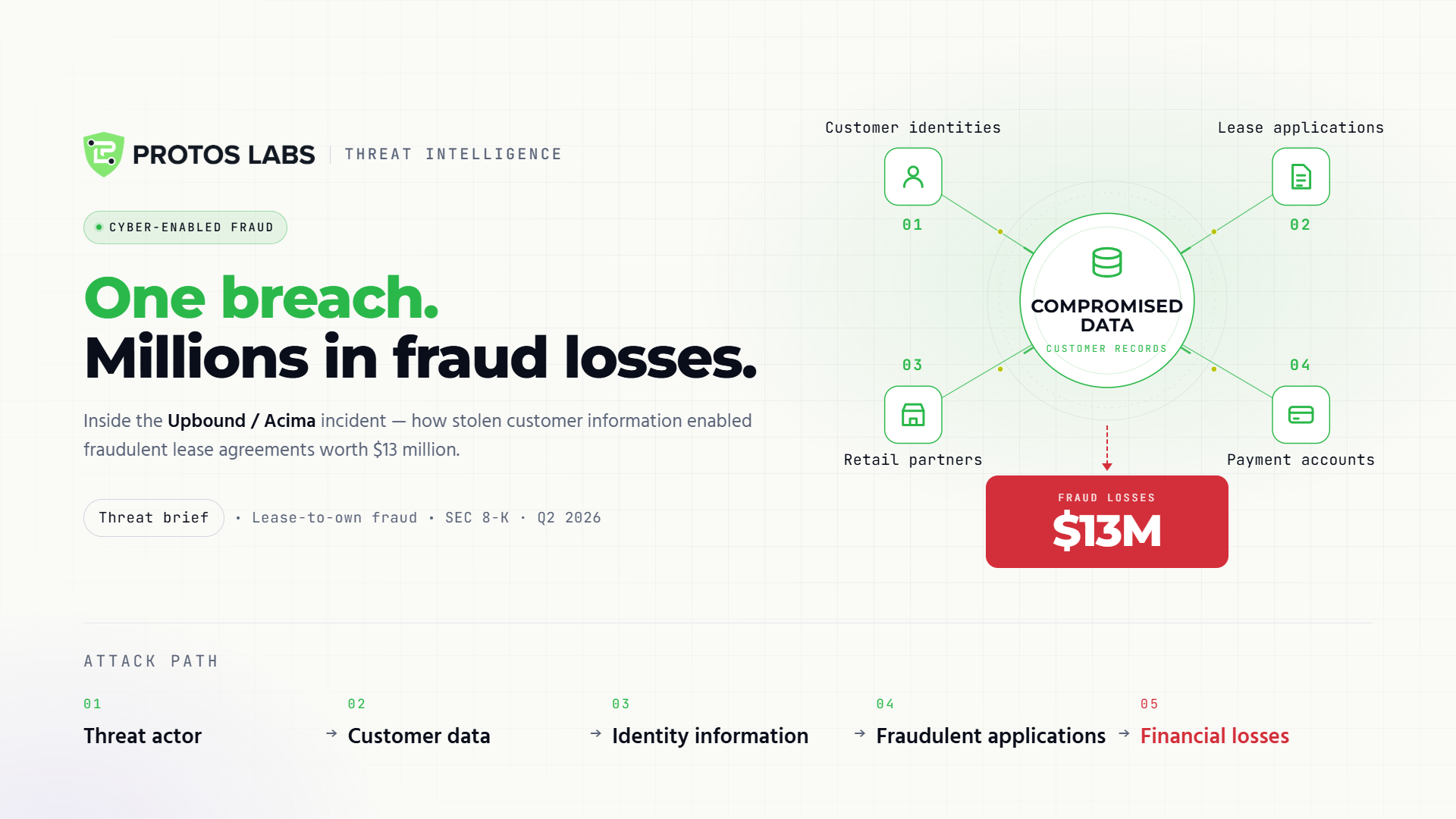
The anchor source is Upbound’s July 21, 2026 Form 8-K, which says certain non-sensitive customer information and other documents were obtained without authorization and were subsequently used to facilitate fraudulent lease-to-own agreements in Acima, producing about $13 million in elevated fraudulent contract losses during Q2 2026.
That means this is best treated as a cyber-enabled fraud case, not a pure privacy event. The confirmed facts are strong: Upbound disclosed unauthorized access, tied the incident to fraudulent Acima contracts, and said it notified federal law enforcement and began mitigation. The unknowns remain equally important: the filing does not identify the actor, does not list the exact exposed fields, and does not prove whether the same party breached the data and executed the fraud.
For a risk leader, the practical takeaway is that exposed customer data can be converted into fast retail-finance fraud when approval, merchant fulfillment, and payment collection are decoupled in time. The report therefore recommends immediate review of lease origination controls, identity-proofing, device/risk scoring, merchant release gating, and loss-model treatment of cyber-derived fraud. The confidence caveat is straightforward: the loss and linkage are confirmed, but the attack path and field-level exposure are not.
Key Judgments
1. The incident is real, material to fraud operations, and clearly linked to Acima losses. HIGH CONFIDENCE
We assess it is almost certain that Upbound experienced a real cyber incident that affected non-sensitive customer information and was later tied to fraudulent Acima lease-to-own contracts, because the primary filing, external coverage, and the loss figure all align on the same core facts.
2. The fraud conversion mechanism is likely new-contract origination fraud, but not all control details are known. MEDIUM CONFIDENCE
We assess it is likely that the stolen information was converted through a new-account or new-contract origination path rather than a simple account-takeover path, because Acima’s lease-to-own model emphasizes instant approval, merchant fulfillment, and immediate merchandise release; however, the exact identity checks and failure points are still unknown.
3. The cyber-as-fraud-enabler thesis is supported, but only to a bounded extent. HIGH CONFIDENCE
We assess it is likely that the cyber incident functioned as a fraud enabler because the filing itself creates a direct chain from unauthorized access to customer data, to use of that data in fraudulent agreements, to measurable losses; nevertheless, the evidence does not prove attacker identity, shared actor overlap, or the exact data elements used.
What We Did
| Area | Summary |
|---|
| Scope | Reviewed the primary 8-K disclosure, corroborating security press, Acima product and privacy materials, and targeted fraud-mechanics notes for the period 2026-04-01 to 2026-07-30. |
| Anchor source | Upbound’s July 21, 2026 Form 8-K is the baseline source for the incident facts and the financial impact statement. |
| Method | Separated confirmed facts from reported interpretation, flagged single-source details, and preserved conflicts between neutral filing language and stronger secondary reporting. |
| Source hierarchy | SEC filing / official Upbound statements first, then vendor/researcher analysis, then security press, then general press if relevant. Source publication dates are listed per source in the external corroboration table below. |
Timeline Reconstruction
This reconstruction uses only the collected evidence in the review set. Where the record is silent, the timeline states that limitation explicitly rather than inferring a precise date.
| Date / Window | Confidence | Event |
|---|
| 2026-04-01 to 2026-06-30 | Medium | The incident-related fraud losses are understood to have accumulated during Q2 2026, but the precise start date of unauthorized access or the first fraudulent contract is not stated in the reviewed materials. |
| Q2 2026 | High | Upbound says the compromised information was used to facilitate fraudulent lease-to-own agreements in Acima, producing about $13 million in elevated fraudulent contract losses during the quarter. |
| Unknown discovery date | High | The official filing does not provide the exact date the incident was discovered. The timeline can therefore only state that discovery occurred before the July 21 disclosure and that mitigation was already underway by that point. |
| 2026-07-21 | High | Upbound disclosed the incident in its Form 8-K, saying certain non-sensitive customer information and other documents had been obtained without authorization and had been used in fraudulent Acima activity; the company also said it had begun mitigation/remediation and notified federal law enforcement. |
| 2026-07-21 onward | Medium | External reporting repeated the filing’s core facts and added a more explicit fraud workflow, while noting the investigation remained ongoing and no leak-site attribution had been identified in the reviewed material. |
Evidence
Primary source anchor and impact
| Source tier | Evidence | Confidence | Interpretation |
|---|
| Primary | Upbound’s 8-K says certain non-sensitive customer information and other documents were obtained without authorization, then used to facilitate fraudulent lease-to-own agreements in Acima. | High | Confirmed breach-to-fraud linkage. |
| Primary | The filing attributes approximately $13 million in elevated fraudulent contract losses to Q2 2026. | High | Confirmed financial impact. |
| Primary | Upbound said it began mitigation/remediation and notified federal law enforcement, while also stating the matter was not material based on current knowledge. | High | Confirmed response posture, but materiality remains Upbound’s view. |
| Unknown | The filing does not state the exact discovery date, actor, intrusion vector, or precise field list. | High | Key unresolved gaps. |
External corroboration and source hierarchy
| Source | Date | What it adds | Confidence | Single-source flag |
|---|
| BleepingComputer | 2026-07-22 | Describes a concrete workflow: stolen data used to obtain goods through Acima’s lease-to-own system, with retailers paid and fraudsters leaving with merchandise and no payments. | Medium | Yes — workflow detail appears only here in this collection. |
| SecurityWeek | 2026-07-23 | Corroborates the filing facts and adds a check for public leak-site attribution absence. | High | Yes — leak-site absence is a reporting-side check, not a filing fact. |
| SC Media | 2026-07-23 | Repeats the core story and mirrors the more explicit fraud-mechanics narrative, but does not independently prove it. | Medium | Yes — mechanism detail remains secondary reporting. |
| FTC guidance | Undated (evergreen guidance) | Supports the broader proposition that stolen personal information can be used for new-account fraud and repeated identity misuse. | Medium | No — general benchmark, not incident-specific. |
Lease-to-own fraud mechanics: what is confirmed vs unknown
| Dimension | Confirmed / reported | Unknown / limited evidence |
|---|
| Origination speed | Acima describes instant approval and immediate merchandise access at merchant checkout. | Exact approval rules and exception handling are not disclosed in the collected sources. |
| Identity proofing | Acima says it uses consumer reporting agency data and multiple data points in application review. | Exact document checks, device checks, liveness checks, or manual-review triggers are not known. |
| Fraud typology | The evidence fits new-account / new-contract origination fraud better than account takeover because the loss is described as fraudulent lease-to-own contracts. | Whether the fraud used synthetic identity, stolen identity, forged documents, collusive merchants, or mule pickup is not established. |
| Why breached data is suitable | Stolen customer information can satisfy identity consistency checks quickly enough to exploit instant approval and same-day fulfillment. | The exact data fields that were exposed in this incident are unknown, so the fit is inferred, not proven. |
Financial and operational impact framing
| Finding | Confirmed | Risk implication |
|---|
| Impact magnitude | Approximately $13 million in fraudulent contract losses in Q2 2026. | Material enough to matter for fraud-loss modeling, merchant controls, and cyber-risk capital narratives. |
| Business model | Lease-to-own combines fast approval, retailer funding, and later payment collection. | Creates a short detection window before goods leave merchant control. |
| Confidence boundary | Confirmed that a breach-linked fraud loss occurred; unknown exactly how the approval bypass happened. | Prevents overfitting response controls to an unsupported hypothesized control failure. |
No ATT&CK mapping is possible because the intrusion vector is undisclosed.
IOC status
No public incident IOCs were identified in the reviewed materials. The disclosure and corroborating reporting focus on data exposure, fraud conversion, and financial impact rather than host-, network-, or malware-level indicators.
Sources
- Upbound official 8-K copy — https://investor.upbound.com/static-files/1854f554-12e9-4db1-93f0-7ee8a1fabd8d
- SEC EDGAR mirror — https://www.sec.gov/Archives/edgar/data/933036/000119312526310605/upbd-20260721.htm
Fraud Conversion Mechanics
Acima’s model is well suited to conversion of stolen customer data into fraud because it combines fast decisioning, merchant-funded fulfillment, and later repayment collection. In practical terms, that means a fraudster only needs the approval path to work long enough to get merchandise released; the economic loss is realized after the goods have already left the merchant or delivery chain.
The conversion path is most consistent with new-account or new-contract origination fraud, not simple account takeover. The loss is described as fraudulent lease-to-own contracts, which implies the attacker needed to pass origination checks, create or hijack a lease application, and then use the approval to trigger retailer fulfillment.
Identity verification pressure points in this type of workflow usually include applicant data entry, consumer-reporting lookups, address and identity consistency checks, device or session risk scoring, and any manual review step. The collected sources do not prove which of those controls Acima used at the time, so the report treats the exact control stack as unknown rather than assumed.
Both stolen and synthetic identities can work in this environment. Stolen identity is the more direct fit for this incident because the filing and secondary reporting describe misuse of compromised customer information, but synthetic identity remains plausible in the broader product class because speed, low-friction approval, and merchandise release are attractive to fraud actors. The evidence set here does not establish which one was used, and it should not be overstated.
Why the breached data is well suited to this fraud type: even non-sensitive customer information can be enough to make a lease application look internally consistent when a system is optimized for speed. If the fraudster can match enough identity attributes to clear the automated gate, the merchant gets paid, the customer-facing obligation gets booked, and the loss materializes later through nonpayment. That is why this event belongs in both the cyber-risk and fraud-risk queues.
Cyber-as-Fraud-Enabler Thesis
The thesis is supported but should not be overstated. The strongest evidence is the causal chain in the 8-K: unauthorized access to customer data, then use of that information in fraudulent Acima agreements, then about $13 million in losses.
External and benchmark material strengthens the interpretation. Security press added a more concrete downstream workflow, and FTC guidance supports the general proposition that stolen personal information can be turned into new-account fraud and repeated identity misuse.
But the evidence also limits the claim. Nothing reviewed here proves an integrated cyber-fraud operator, proves that the same actor conducted the breach and the fraud, or proves which exact data elements were used. The better-supported conclusion is a breach-as-data-supplier model: cyber exposure created reusable identity material that was then monetized through a retail-finance fraud channel. An integrated cyber-fraud campaign remains possible, but it is unconfirmed.
For a risk leader, that distinction matters. If this was breach-as-data-supplier, the response should focus on identity proofing, fraud scoring, merchant release gating, and consumer monitoring. If an integrated campaign is later confirmed, the organization should also look for control-plane overlap, shared infrastructure, and potentially broader compromise of internal systems. The current record supports the first model much more strongly than the second.
Alternative Hypotheses
| Finding | Alternative Explanation | Why Accepted / Rejected |
|---|
| Fraud losses linked to stolen customer data | Losses may have come from unrelated internal fraud or merchant-side abuse. | Rejected because the filing directly links the cyber incidents to fraudulent lease-to-own agreements. |
| Exact exposed fields remain unknown | The collected materials may simply be incomplete. | Partially accepted as a collection limitation, but no reviewed source enumerated the exact fields, so the report must stay bounded. |
| Fraud mechanism appears to be origination fraud | The event could instead be account takeover or servicing abuse. | Less likely because the losses are described as fraudulent lease-to-own contracts, which fits new-contract fraud better than servicing abuse. |
| Cyber-as-fraud-enabler thesis | The incident and the fraud may simply be temporally correlated. | Rejected at the business-risk level because the 8-K explicitly ties the data compromise to the fraudulent agreements. |
Information Gaps & Limitations
- Gap: The exact incident-exposed fields remain unknown. Impact: Limits precision on identity-theft exposure, consumer notification priorities, and downstream fraud scoping.
- Gap: The actor, intrusion vector, and whether one party both breached and committed the fraud are unconfirmed. Impact: Prevents attribution and constrains technical hardening recommendations to generic fraud-control improvements.
- Gap: The official disclosure does not identify the precise fraud-control failure point. Impact: Defenders should avoid assuming whether the failure was document verification, device scoring, manual review, or merchant behavior.
- Gap: No public incident IOCs were identified. Impact: This report cannot support endpoint or network hunting from public indicators alone.
- Gap: The filing says Upbound currently believes the matter is not material, but the future reassessment path is unknown. Impact: The business significance could change if additional facts emerge.
Recommendations
- Obtain the consumer notice or regulator filing that lists the exact exposed fields. This is the main unresolved gap and would materially improve identity-risk assessment, customer notification, and watchlist prioritization.
- Review Acima origination controls end to end. Focus on identity verification, consumer-reporting inputs, device and behavioral scoring, document validation, manual review thresholds, and merchant release gating.
- Treat cyber-derived fraud as a combined loss event in models and governance. The confirmed breach-to-fraud linkage means cyber and fraud teams should share telemetry and loss analytics rather than operate separate playbooks.
- Stress-test merchant-side and instant-approval processes. Retail-finance products with immediate fulfillment need tighter pre-release checks because post-approval detection arrives too late to prevent merchandise loss.
- Preserve the confidence boundary in executive reporting. Report the loss and linkage as confirmed, but avoid overstating actor identity, exact exposed fields, or integrated cyber-fraud attribution until evidence exists.


.png)